

product

Industrial Water-Based Acrylic Anti-Rust Paint | Professional Metal Coating
MORE DETAILS
- Product Composition
- Product Features
- Technical Datas
- Product Application
- Surface Treatment
- Construction Condition
- Construction Guidance
- Matching Paint
- Construction Method
- Precautions
- Storage and Self Life
- Package
*Product Composition:
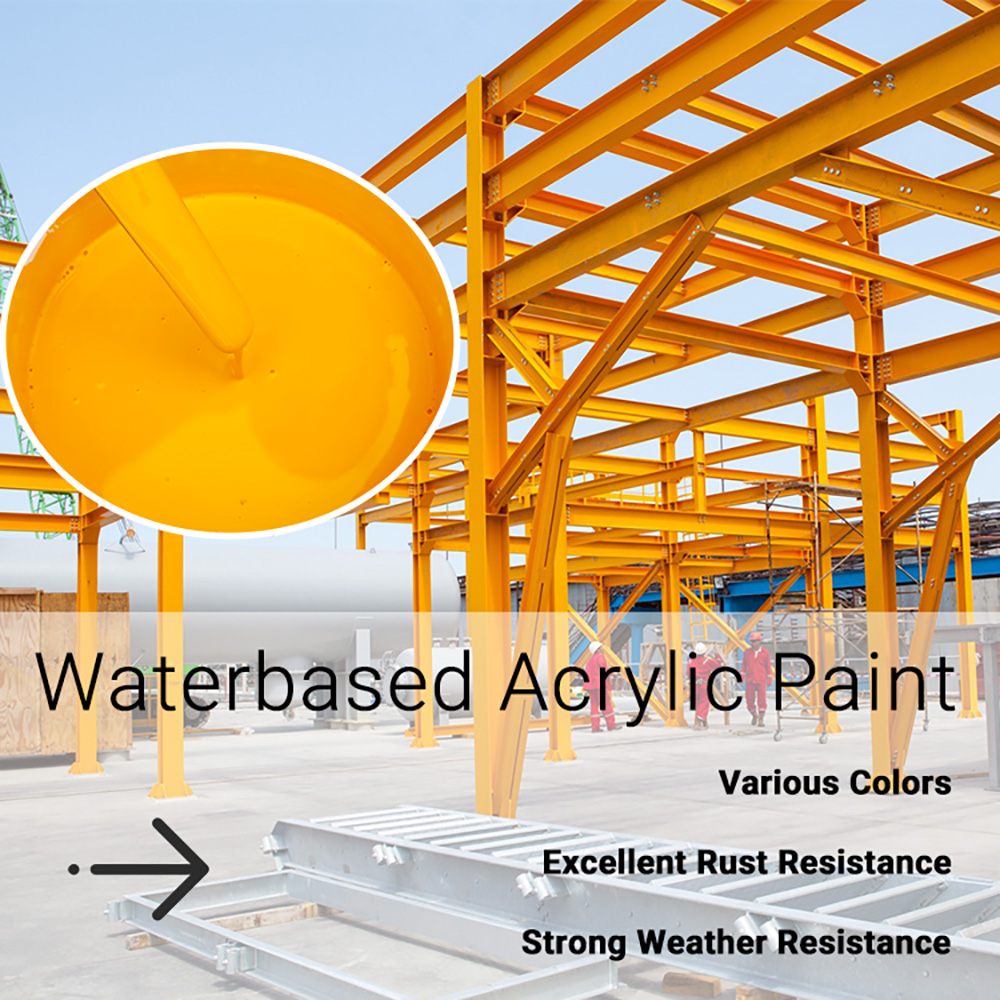
*Product Features:
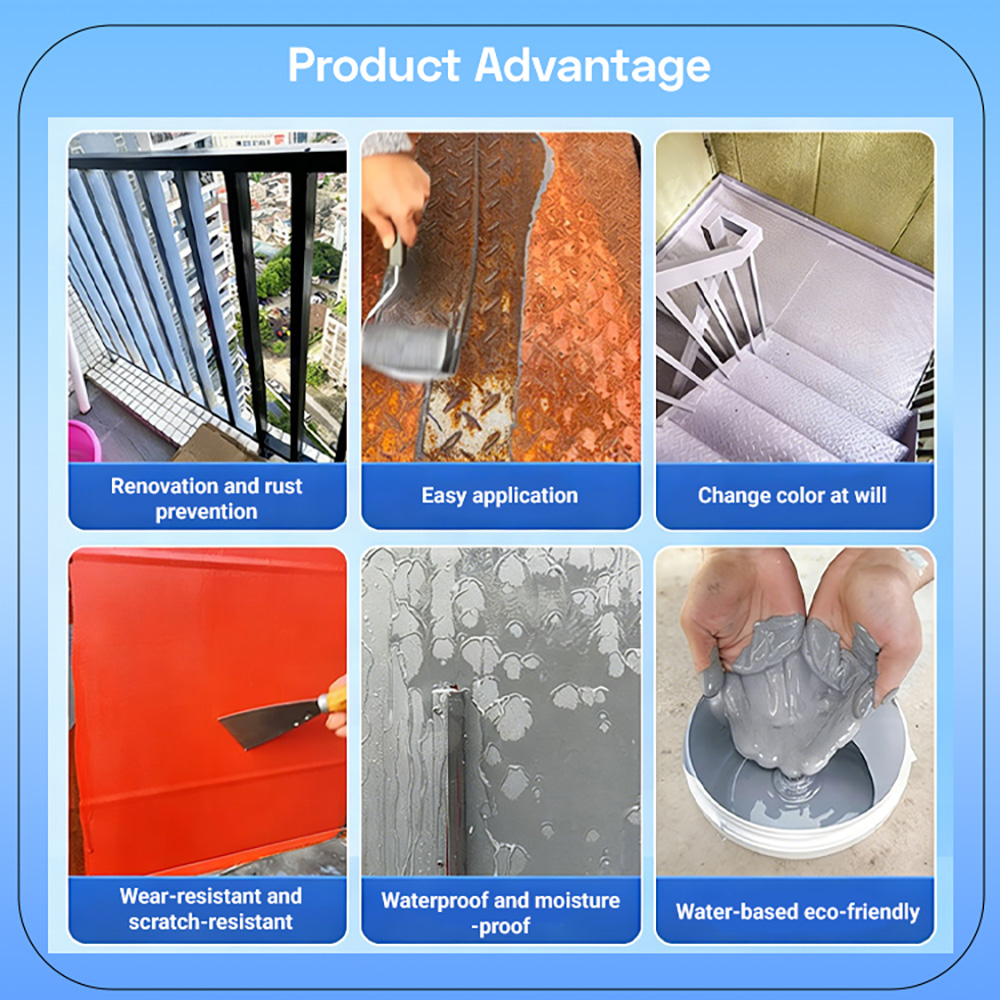
. Strong weather resistance: UV-resistant, acid- and alkali-resistant, resists chalking and fading with long-term use.
. Excellent adhesion: Strong adhesion to a variety of substrates, including metal, wood, concrete, and plastic.
. Eco-friendly and safe: Low VOC, contains no harmful substances such as benzene and formaldehyde, and making it suitable for indoor and outdoor environments.
. Quick drying and easy application: Surface drying takes approximately 30 minutes at room temperature.
. Various colors: A variety of colors can be blended, with long-lasting color retention.
*Technical Datas:
|
No. |
Items |
Qualification |
|
1 |
The state of a material in a container |
No caking, uniform state after stirring |
|
2 |
Thermal storage stability(50±2)℃/7d |
No abnormalities |
|
3 |
Non-volatile matter content, % |
≥35 |
|
4 |
Fineness, μm |
≤40 |
|
5 |
Freeze-thaw stability (3 cycles) |
No deterioration |
|
6 |
Dry time (25 ℃), h |
Surface dry≤2 |
|
Hard dry≤24 |
||
|
7 |
Color and appearance of paint film |
Colors and smooth film |
|
8 |
Impact resistance, kg·cm |
≥40 |
|
9 |
Bending test,grade (Grid spacing 1mm) |
≤1 |
|
10 |
Hardness (Pencil hardness) |
≥2B |
|
11 |
Density,g/cm3 |
1.1-1.3 |
|
12 |
Coating film thickness |
Dry film 20~30μm/coat, wet film 50~70μm/coat |
|
13 |
Solid content, % |
≥60 |
|
14 |
Water resistance (24h) |
24hrs no blistering or shedding, slight discoloration is allowed |
|
15 |
Salt water resistance(3% NaCl ) |
96 hrs no blistering or rusting, slight discoloration is allowed |
|
16 |
Weather Resistance |
Artificial accelerated aging 500 h |
|
Powdering≤ 1 grade |
||
|
Discoloration≤ 2 grade |
||
|
Loss of gloss≤ 2 grade |
*Product Application:
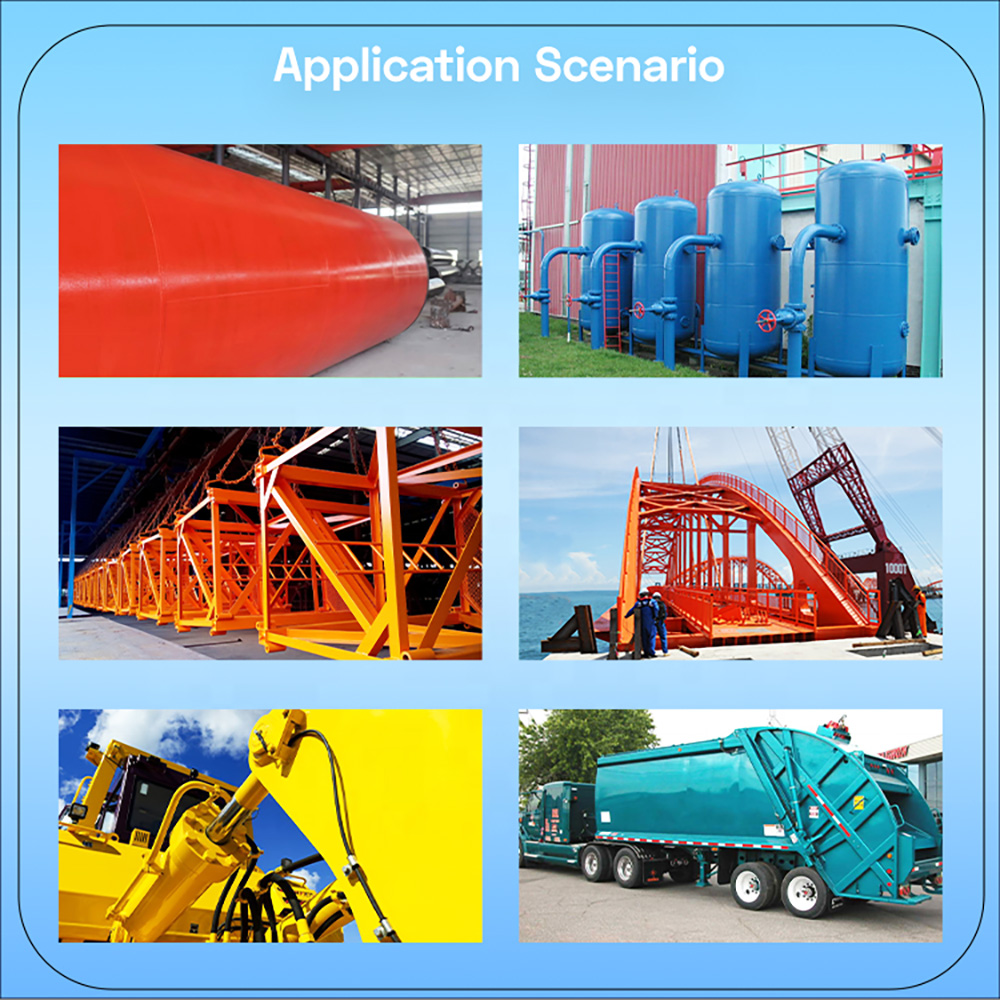
Widely used for surface decoration and protection of outdoor metal surfaces such as doors and windows, pipes, metal roofs, subway guardrails, highway railings, streetlight poles, fences, metal frames, and partitions. Industrial corrosion protection is also provided for steel bridges, storage tank exteriors, power plant pipelines, and port machinery. It also serves as a decorative and protective coating for agricultural machinery, vehicles, machines, and equipment. It can also be used in marine environments such as offshore facilities and ship decks (requires a complementary reinforced coating).
*Surface Treatment:
To ensure film adhesion and long-term corrosion protection, the substrate surface must be thoroughly cleaned of oil, rust, scale, old paint, and loose impurities before application. Preparation standards should meet the following:
All surfaces to be coated should be clean, dry and free from contamination. Before painting, all surfaces should be in accordance with the ISO8504: 2000 standard evaluation and processing.
The scaled steel is blasted to Sa2.5 grade, surface roughness is 30-75μm, or pickled, neutralized and passivated;
Oxide-free steel blasted to Sa2.5 grade, or polished to St3 grade with pneumatic or electric elastic grinding wheel;
Steels coated with workshop primer paint film damage, rust and white rust on zinc powder primer should be derusted twice, white rust is removed and polished to St3.
Other surfaces This product is used for other substrates, please consult our technical department.
*Construction Condition:
The substrate temperature is not lower than 5 ℃, and at least 3℃ higher than the air dew point temperature and the relative humidity is <85% (temperature and relative humidity should be measured near the substrate).Construction is strictly prohibited in fog, snow and windy weather.
*Construction Guidance:
Step 1: Substrate Surface Preparation (The Key Step)
The quality of surface preparation directly determines the adhesion and lifespan of the paint film.
Metal surfaces must be degreased and rust-free (to Sa2.5 or St3 standards) to ensure metal surfaces to be painted must be thoroughly clean, completely dry, and free of contaminants such as oil, grease, dust, salt, scale, and loose old paint.Visible moisture or condensation is not allowed.
The treated surface should meet the design cleanliness and roughness standards, and paint should be applied as soon as possible to prevent rust recurrence or secondary contamination.
Step 2: Apply Primer (Optional)
To enhance overall corrosion protection, apply one coat anti rust primer.
Step 3: Apply Waterbased Acrylic Topcoat
After open the bucket, stir evenly by electric mixer especially any pigments and fillers that have settled at the bottom.Then brush/roll or spray, air spraying is the preferred method for obtaining the smoothest and flattest paint film. If you have professional equipment and techniques, it will be best.The theoretical paint consumption is 0.2kg/m²/coat.(Actual usage may vary depending on surface texture, porosity, application method and operator technique.)
Note:
*If need thinning, dilute with deionized water according to the application viscosity and method (brushing, rolling, or spraying). Adjust the viscosity to suit the specific application method.
* Dilution ratio of 5-20% by weight. Over-thinning will adversely affect film build, hiding power, and long-term durability.
* Before applying the next coat, ensure the previous coat is fully cured, clean, dry, and free of all contaminants.
* Avoid vigorous stirring to prevent the introduction of excessive bubbles.
*Matching Paint:
Mildly Corrosive Environment (C2):
One coat of waterborne epoxy primer + two coats of waterborne acrylic anti-corrosive topcoat.
Moderately Corrosive Environment (C3-C4):
One coat of waterborne inorganic zinc-rich primer + one coat of waterborne epoxy micaceous iron intermediate + two coats of waterborne acrylic anti-corrosive topcoat.
*Construction Method:
Spraying: Airless spraying or air spraying. It is recommended to use high-pressure airless spray.
Brushing/Rolling: The specified dry film thickness must be achieved.
*Precautions:
▶ Environmental Requirements: Application temperature: 5°C-35°C (Specific adjustments are made according to product characteristics), relative humidity ≤85%.
▶ Compatibility testing is required when mixing with solvent-based paints (a small area test is recommended).
▶ Protective equipment must be worn during sandblasting
▶ Protect from freezing during storage.
▶ Fog, rain, snow, wind and rain is strictly prohibited construction.
*Storage and Self Life:
▅ Store in a cool, dry, ventilated indoor warehouse at a temperature of 5-35 ℃, avoid freezing and direct sunlight;
▅ The self life is 12 months. If products that exceed the storage period can be used after passing the inspection.
*Package:
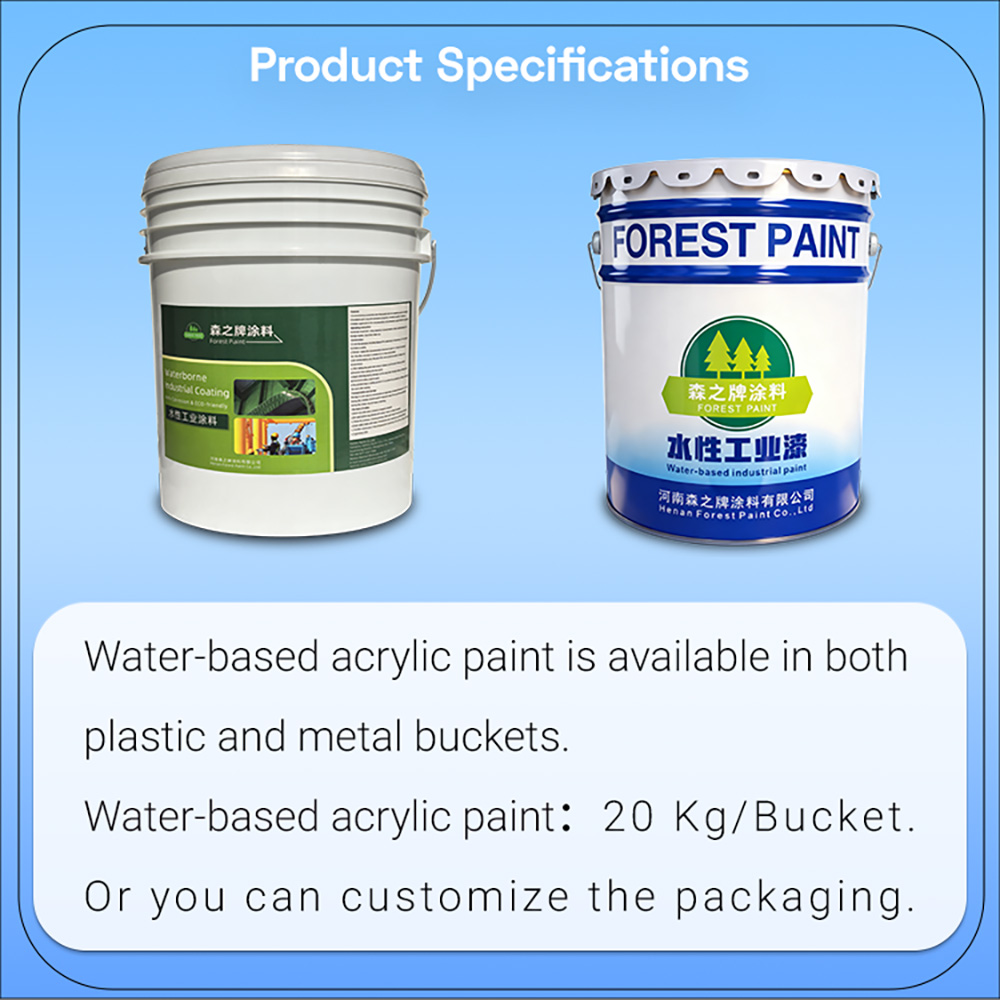
20 Kg/Bucket or customized package.
Related Products
-

Acrylic Enamel Lacquer Thinner Car Paint Mixing...
-
Automotive Acrylic Enamel Refinishing Car Paint...
-
Free Sample Chemical Resistant 1k Acrylic Car R...
-
High Performance Waterborne Acrylic Enamel Paint
-

Industrial Coating Steel Structure Acrylic Poly...