

Recently, “France experienced its hottest day on record, with temperatures reaching 40°C, more than 44 million people received the highest level of warning…” I was shocked by this news. Air conditioning is often considered an “unnecessary luxury” in France, because the the actual cooling need is only for 2-3 weeks a year—”just bear it.” Installation costs are also big for some people. Therefore, in the sweltering French summers, homeowners choose applying Forest Paint heat reflective waterproof coating to reduce temperature, especially white roof paint. This not only helps lower indoor temperatures but also solves the problem of leaky roofs. This article compares installing air conditioning with applying heat reflective paint to help you decide which to choose.
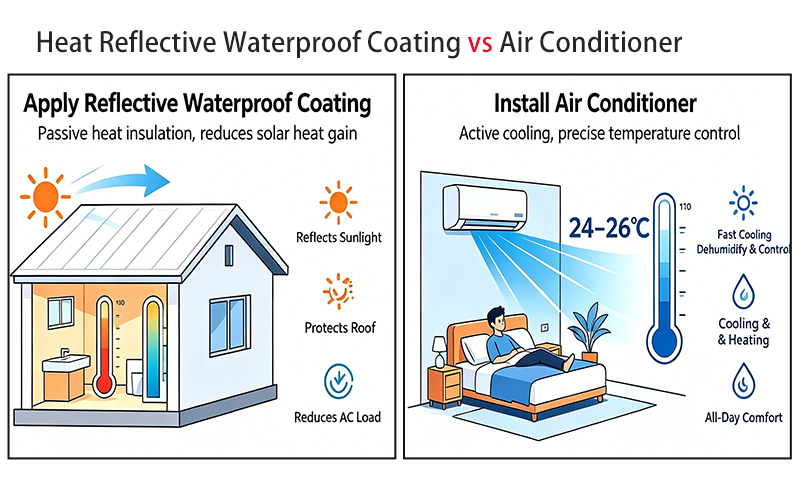
We briefly summarize their differences between heat-reflective waterproof coatings and air conditioner,as followings:
|
Comparison Item |
Forest Paint Brand Heat-Reflective Waterproof Coating |
Air Conditioner |
|
Cooling Principle |
Reflects sunlight to prevent heat from entering buildings (passive cooling, zero energy consumption) |
Active refrigeration that removes indoor heat (continuous power consumption) |
|
Cooling Effect |
Passive temperature reduction; reduce temperature can drop by up to 10–20°C |
Instant rapid cooling once turned on; precise indoor temperature control available |
|
Initial Cost |
Extremely low |
Extremely high |
|
|
Zero energy consumption. No electricity required after application; functions via physical properties |
High energy consumption |
|
|
Low.Coating can lasts 8–10 years. With waterproof effect (seals roof cracks). Only regular surface dust washing is needed (dust reduces reflectivity) |
Costly. Pay electricity bills special in summer. Regular maintenance |
|
Environmental Protection & Noise |
Silent, friendly Environmental |
Generates operating noise |
|
Application Scenarios |
Exposed roof areas: warehouse roofs, factory roof etc. |
Rental housing, temporary prefabricated houses, short-term shops,Bedrooms, offices |
Product Description:
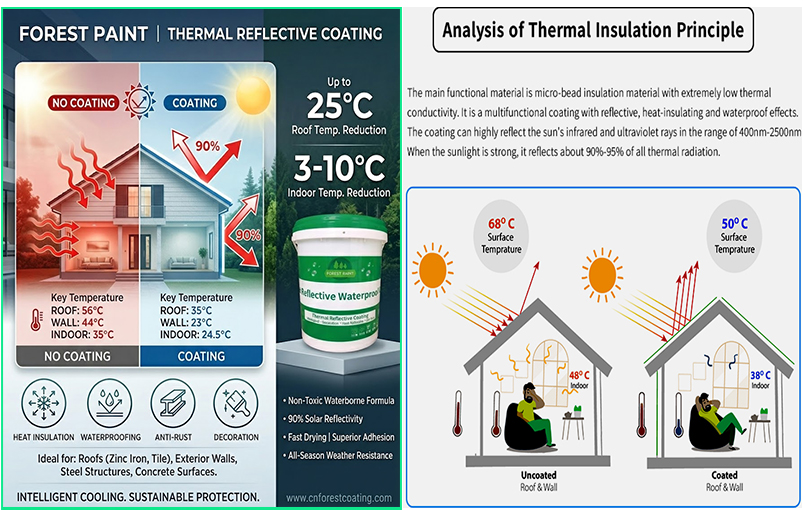
The heat reflective waterproof coating is composed of acrylic emulsion, titanium dioxide, hollow glass beads, and additives. It reduces indoor temperature by reflecting most of the sunlight off its covered surface, preventing heat absorption. Coatings belong to waterborne and single component, non-toxic and harmless, the reflectivity of the coating to solar heat can reach 90%. On sunny days, when the indoor temperature exceeds 33°C, the indoor temperature after applying the heat reflective waterproof coating can be reduced by 3-10°C compared to the uncoated indoor temperature, and the roof temperature can be reduced by 10-25°C. The higher the temperature, the more obvious the heat insulation effect.
Features:
● Excellent heat-reflective properties: Reflectivity ≥ 85%, hemispherical emissivity ≥ 80% effectively reducing surface temperatures by 10-25°C, reducing air conditioning energy consumption and contributing to energy conservation and environmental protection.
● Excellent waterproofing and sealing: The coating exhibits excellent elasticity, resists cracking, seamlessly covers the substrate, and resists long-term water immersion, preventing leakage.
● Weather-resistant: UV-resistant and resistant to high and low temperatures (-40°C to 120°C), it adapts to various climates and has a service life of 5-10 years.
● Environmentally friendly and safe: Water-based formula, low VOC, non-toxic and odorless.
● Easy application: Support brush, roller, or spray, compatible with substrates (concrete, metal, asphalt, etc.), dries quickly, and has excellent adhesion.
Applications:
Suitable for thermal insulation and waterproofing of exterior walls, roofs, balconies, etc. It can also be used for cooling protection of oil storage tanks, chemical plants, pipelines, cold storage, etc. It can also be used for waterproofing, rust prevention, thermal insulation, and cooling of concrete surfaces, steel structures, galvanized surfaces, etc.
Based on the above understanding of their characteristics, here are some usage suggestions:
* For rooftops/colors sheet steel structures/large factories, long-term owner-occupied, roof leaks requiring renovation → prioritize applying heat reflective waterproof coating, then install air conditioning.
* For bedrooms/offices/server rooms/kitchens, requiring constant temperature and dehumidification, lower floors without direct sunlight, short-term use → install air conditioning directly.
* For limited budgets, warehouses/corridors not requiring low temperatures, no conditions for air conditioning installation → only apply heat reflective waterproof coating.
In France, where the climate varies by region, the application of heat reflective waterproof coatings is particularly important. In the sweltering heat of the south, homeowners choosing these coatings can immediately alleviate the heat. Furthermore, in densely built-up urban areas like Paris, the reflective properties of these coatings help lower the temperature of the entire block, benefiting all residents.
In short, air conditioning solves the problem of “whether it’s hot now,” while coatings solve the problem of “whether it’s hot in the future.” With high electricity prices in 2026, coatings represent the highest-return “long-term investment,” but air conditioning is a basic necessity for survival. If you want to test Forest Paint Heate Reflective Waterproof Paint, welcome to contact our sale teams to know more details and samples.
Post time: Jul-01-2026