

Wood is belongs to flammable material, Wood burns easily when meet an open flame or high temperatures. The main purpose of using wood fire resistant paint and wood flame retardants coating is to reduce the fire risk of wood, slow the spread of flames, and get more time for evacuation and firefighting. Therefore, in construction, furniture, and interior decoration, flame retardant treatments are commonly used to improve the fire safety performance of wood. While both wood fire resistant paint and wood flame retardant are used to improve the fire resistance of wood, their mechanisms of action, usage, the protective layer they form, and applicable scenarios differ significantly. Today, we discuss these differences to help more people choose the suitable for their product.
What is Wood Fire Resistant Paint?
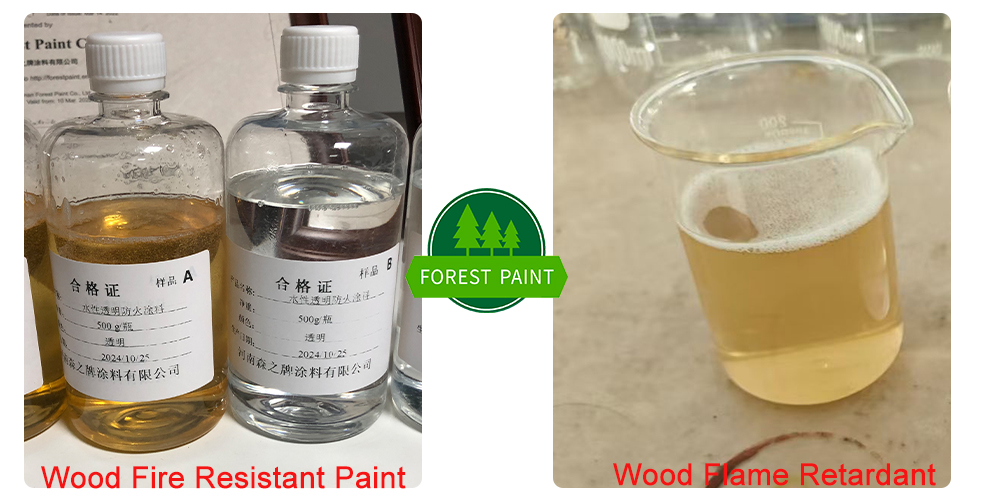
It is two-component water-based paint, consisting of epoxy resin, phosphorus and nitrogen compounds, surfactants, flame retardants, carbon formers, foaming agents, film-forming substances, water, alcohol, etc. And It is a new type of water-based transparent fire retardant paint with the advantages of high transparency, good fire retardant effect, and good weather resistance.When used, mix the AB components evenly according to the proportion, apply them to the wood surface, and after self drying, a transparent fire-retardant coating will be formed. When encountering flames, the coating will expand into a non-combustible honeycomb porous carbon layer, which can insulate heat and oxygen and protect the wood from being ignited.
Application:Wood structures: beams and columns of ancient buildings, wooden floors, wooden partitions;
Commercial spaces: decorative wood or fabrics in hotels and exhibition halls;
Home furnishings: children’s room furniture, solid wood cabinets, stairs;
Public facilities: schools, theaters and other fire-resistant areas with high aesthetic requirements;
It also widely use for soft/hard wood with a thickness of more than 10 mm, and other wood structure products, such as plywood, cardboard, fiber insulation board and plywood with a thickness of more than 12 mm
What is Wood Flame Retardant?
It is a water-based inorganic flame retardant, penetrant, non-halogen and heavy metal and other prohibited ingredients. It is a light yellow liquid, easily soluble in water, and also soluble in urea-formaldehyde glue. It has good stability, not easy to fail, non-volatile, non-toxic and environmentally friendly, has excellent smoke suppression and flame retardant effects, and has excellent anti-corrosion, anti-moth function is a more ideal wood fire retardant which has come out on the market today.
This product has changed many shortcomings of traditional flame retardants, which are easy to return to moisture and low flame retardant grade, and is an environmentally friendly flame retardant with excellent performance in the world. After treatment with this product, wood, cotton and linen fabrics and other products have long-lasting flame retardancy, will not generate heat during use, will not be decomposed by light, will not be easily hydrolyzed and lost, have low moisture absorption and stable dimensions. Its physical properties and process performance are not affected, and its visual, tactile and regulatory environmental characteristics are basically the same as.
Application:It is suitable for natural wood, plywood, packaging boxes, medium-density fiberboard, particleboard, textiles, cotton and linen products, fabrics, paper and other raw materials and semi-finished products. It can also be used in construction projects such as wooden houses, wooden roofs, fire-resistant panels, schools, theaters, shopping malls, parking lots and other public places with strict fire protection requirements, and wooden stairs, cabinets, floors and other furniture decorations.
Key Differences Between Wood Fire Resistant Paint and Wood Flame Retardant:
|
Items |
Wood Flame Retardant |
Wood Fire Resistant Paint
|
|
Type |
Water-based |
Water-based |
|
State |
One part, liquid |
Two part, liquid |
|
Main Function |
Reduces the flammability of wood and slows flame spread |
Forms a protective layer to delay heat transfer and burn |
|
Construction method |
Spraying, brushing or soaking |
Brushing, rolling or spraying |
|
Working principle |
Penetrates into or treats the wood fibers to improve fireproof properties |
Penetrates into wood fibers to forms a protective film; intumescent type, expands when meet fire |
|
Protection area |
Inside or on the surface of wood |
Mainly on the wood surface |
|
Film Formation |
Generally does not form a thick coating film |
Forms a continuous coating film |
|
Intumescent effect |
Non-intumescent |
Intumescent |
|
Applications |
Timber, lumber, wooden boards and wood processing |
Wooden beams, ceilings, wall panels, doors and decorative wood |
|
Maintenance |
Require re-treatment depending on exposure conditions |
Require re-coating if the protective film is damaged |
|
Price |
Low |
High |
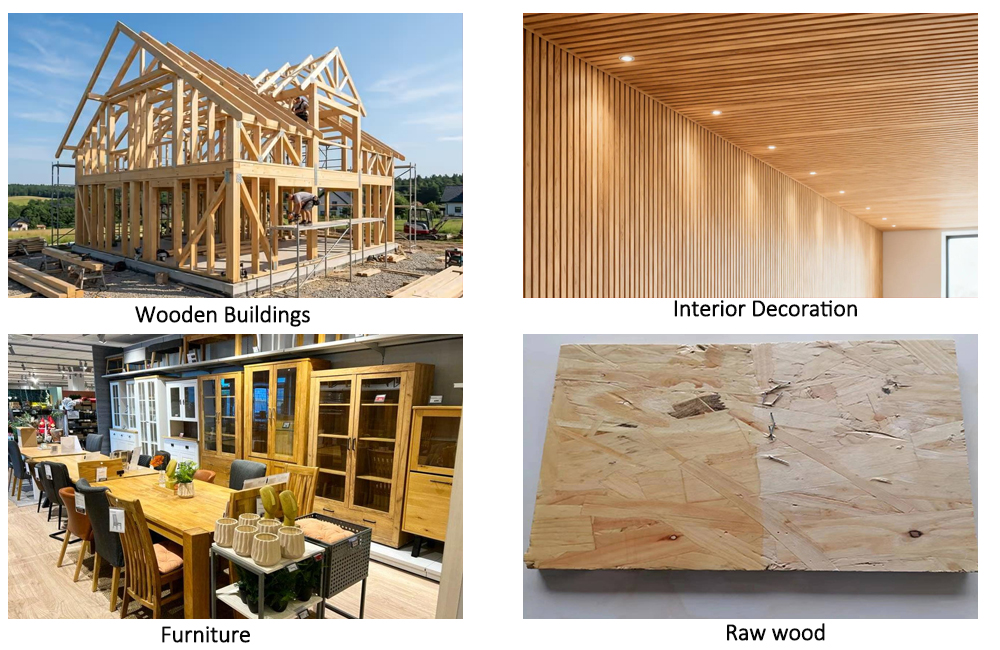
Wood is a combustible material and can catch fire easily when exposed to flames or high temperatures.Wood flame retardants and fire resistant paint are used to improve the fire performance of wood, slow down flame spread, and reduce fire hazards.They are widely used in wooden buildings, furniture, wall panels, ceilings, doors, hotels, schools and other public buildings.These treatments help improve fire safety, but they do not make wood completely fireproof.
Wood fire resistant paint and wood flame retardant are very important for fire safety. Understanding their differences in composition, application, and effectiveness will help you make an informed decision that best suits your needs. Whether you chooser the wood fire resistant paint or wood flame retardant, investing in fire safety is a vital step in protecting your property and ensuring the safety of its occupants.
Post time: Nov-18-2026