

In our daily sales of line marking paint, we often encounter a troublesome problem: many customers cannot distinguish between “reflective paint” and “glow-in-the-dark paint” when purchasing, often confusing the two. As a result, after buying the paint and applying it, they find that the effect is completely different from their expectations, and they complain that it is a problem with the paint quality, which delays and losses. This article will explore the characteristics, mechanisms of action, and applications of these two types of paint to help you understand their differences and their respective applicable scenarios.
What is Reflective Paint?
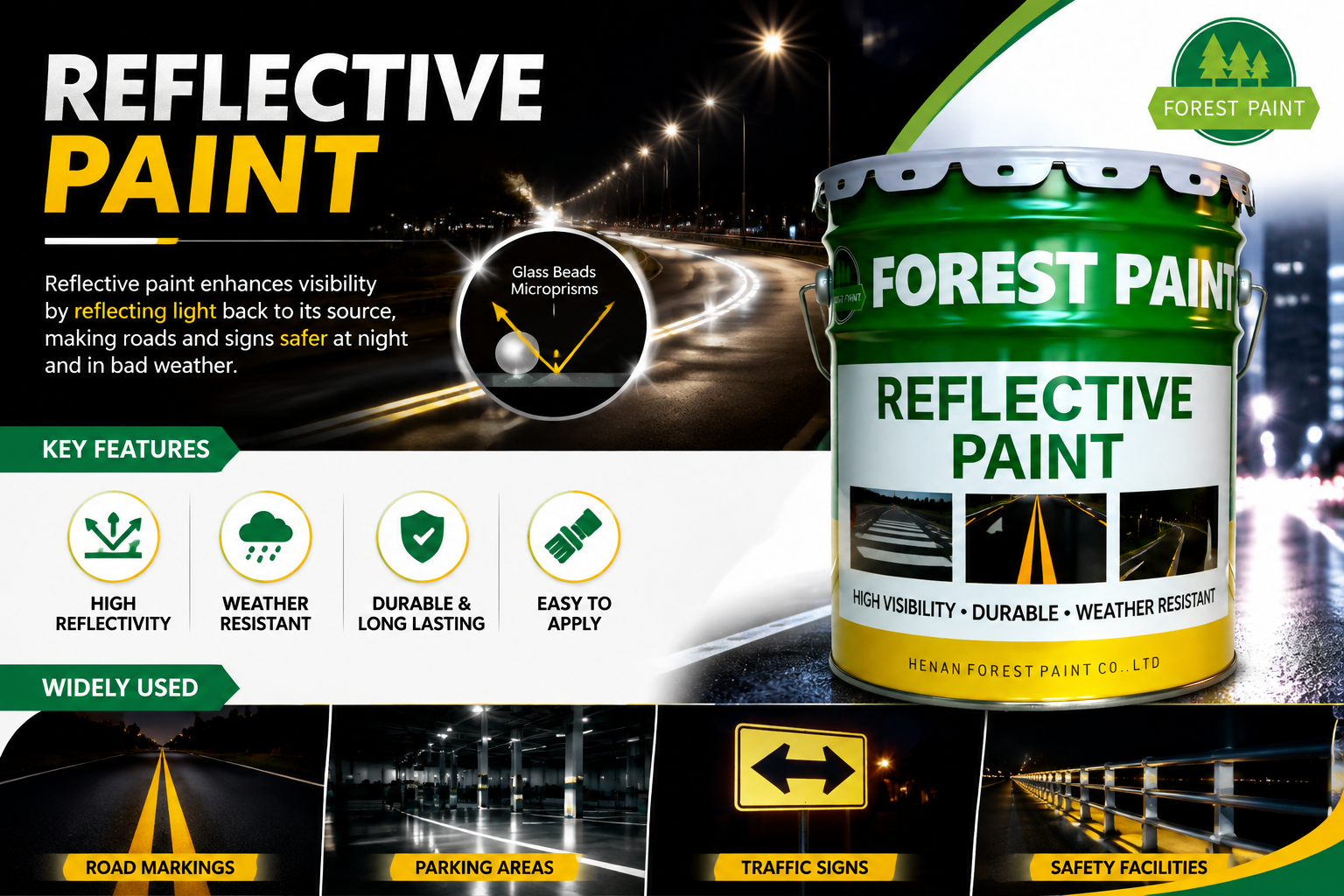
Reflective paint is a specialized coating, it composed acrylic resin, which serves as the base material. This paint is mixed with a specific proportion of directional reflective materials, such as glass beads or microprisms, which enhance its reflective properties. The primary purpose of reflective paint is to increase visibility in low-light conditions, making it an essential component in various safety applications.
It widely used in traffic management, road markings, and safety signage. Its ability to reflect light back to its source makes it invaluable for guiding drivers and pedestrians, especially at night or in adverse weather conditions. The reflective properties of this paint can significantly reduce accidents and improve overall safety on the roads.
What is Glow in the Dark Paint?
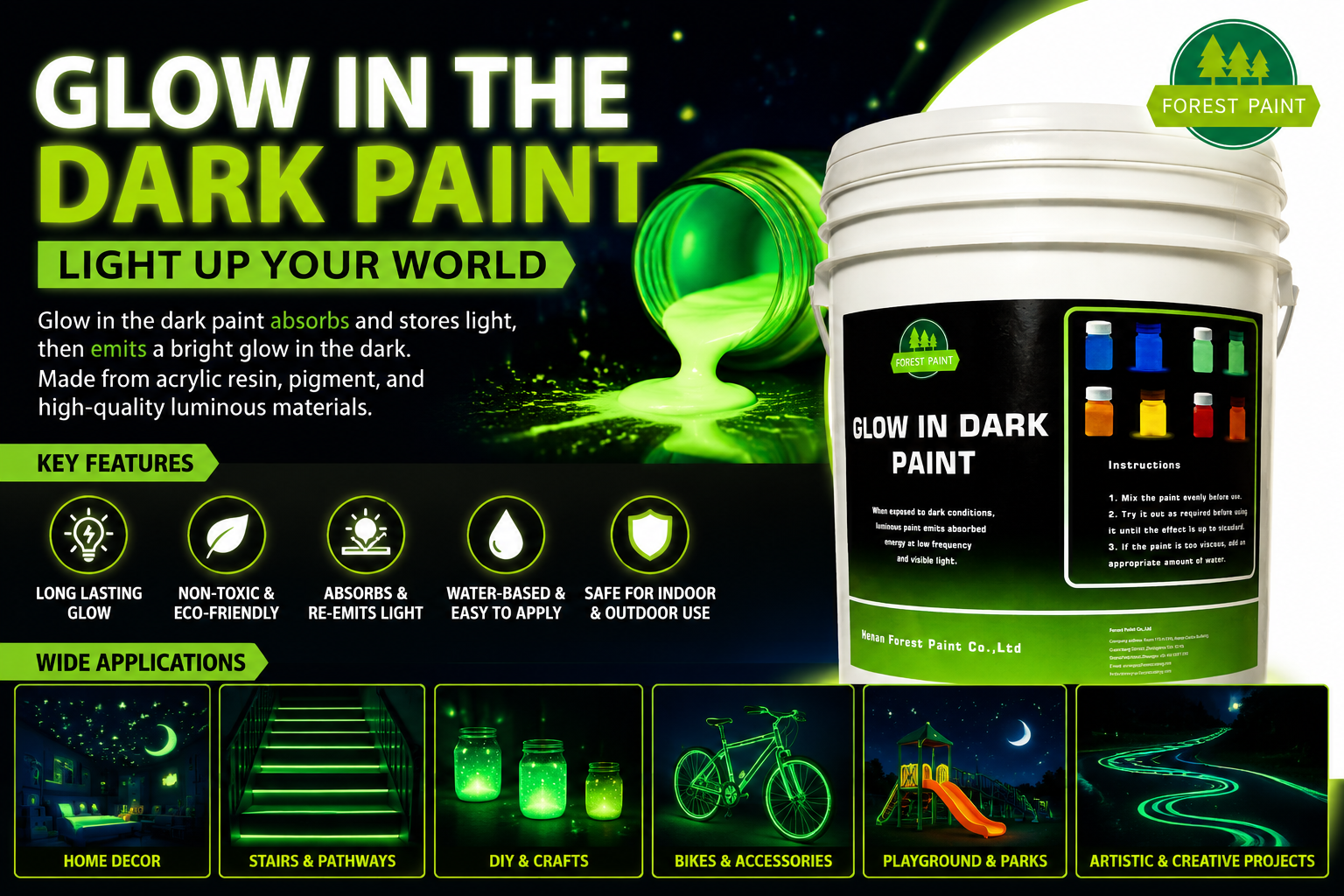
Glow in the dark paint is a unique type of paint that possesses the ability to emit light in dark environments. It is made from acrylic resin, pigment, and luminous pigment, which is ground and mixed with additives to enhance its performance. This paint absorbs natural or artificial light and then re-emits it in the dark, creating a glowing effect.
The glow in the dark paint is non-toxic and environmentally friendly, making it safe for various applications, including children’s toys, home decor, and artistic projects. Its ability to store light and glow repeatedly makes it a popular choice for creating visually striking effects in both indoor and outdoor settings.
|
Feature |
Reflective Paint |
Glow-in-the-Dark Paint |
|
Working Principle |
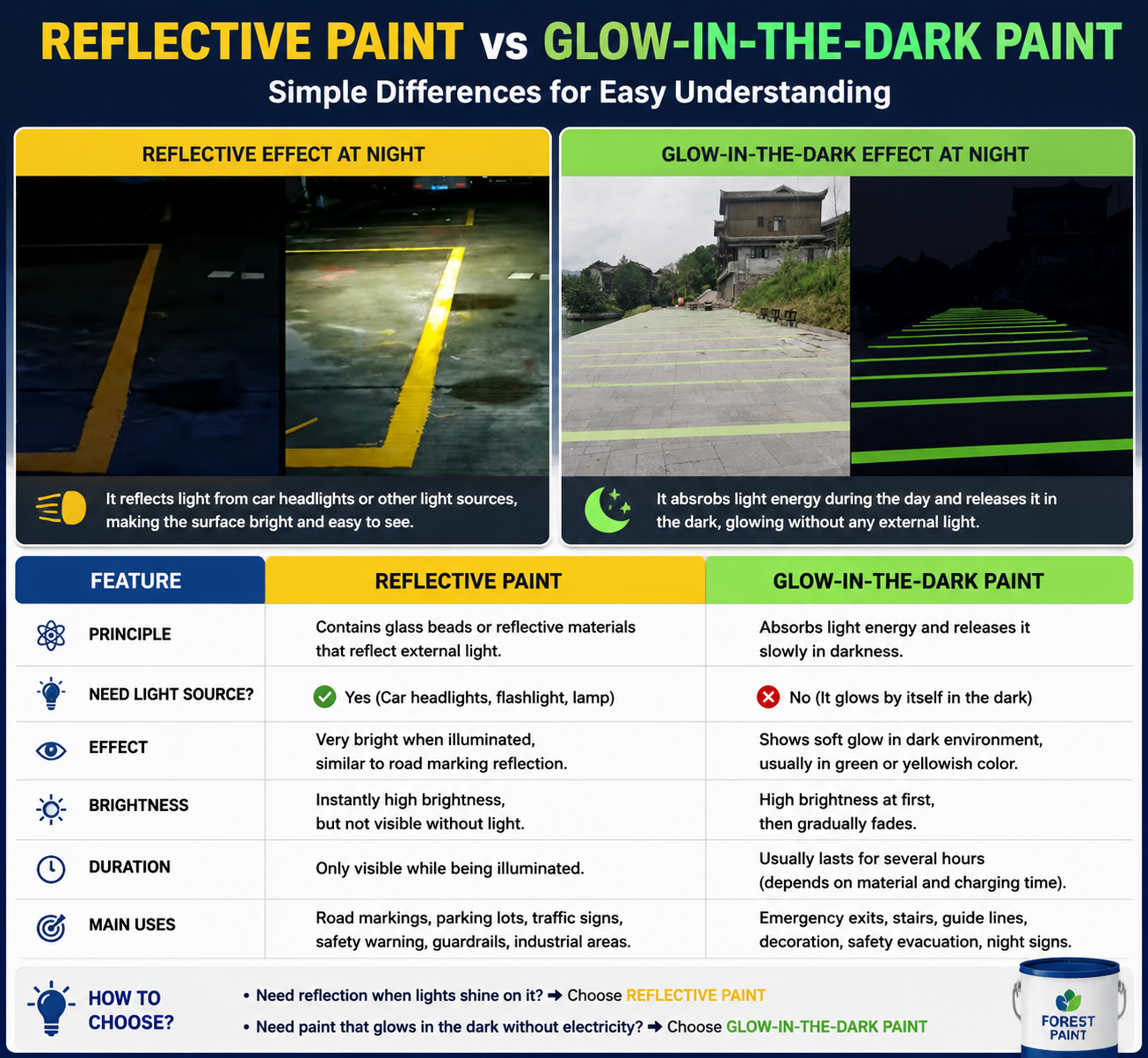
“Reflects light”. Its core component is high-refractive-index glass microspheres, which can reflect the light from headlights and other light sources back to the driver. |
“Stores and releases light energy”. It absorbs and stores light energy during the daytime or under light exposure, then slowly releases the stored energy in a dark environment to achieve self-luminous effects. |
|
Key Features |
It must be illuminated by an external light source (such as vehicle headlights) to shine. Without light exposure, it will not emit light or reflect light. |
After absorbing enough light, it does not require an external power source or lighting. It can glow automatically, and the brightness gradually decreases over time until it absorbs light again. The afterglow can last approximately 8–12 hours. |
|
Lighting Conditions |
Requires direct illumination from a light source such as vehicle headlights. |
Only needs exposure to daylight; it glows in the dark. |
|
Performance in Darkness |
Does not glow without light exposure. |
Continuously emits light for several hours in darkness. |
|
Typical Applications |
Mainly used for warning and identification purposes, requiring visibility at a distance under light sources. Examples: road signs, traffic markings, vehicle signs, parking lot markings, and construction site warning areas. |
Mainly used for guidance and indication in dark environments without electricity. Examples: emergency exits, fire safety signs, evacuation routes, safety indicators, and decorative applications. |
Mechanism of Light Emission
Reflective Paint
The reflective properties of reflective paint are primarily due to the inclusion of directional reflective materials. When light hits the surface of the paint, these materials reflect the light back towards its source. This mechanism is similar to how a mirror works, allowing for maximum visibility. The effectiveness of reflective paint can vary based on the angle of the light source and the quality of the reflective materials used.
Glow in the Dark Paint
Glow in the dark paint operates on a different principle. The luminous pigments within the paint absorb light energy when exposed to natural or artificial light. Once the light source is removed, these pigments release the stored energy in the form of visible light, creating a glowing effect. The duration and intensity of the glow depend on the quality of the luminous pigments and the amount of light absorbed. High-quality glow in the dark paints can glow for several hours after being charged.
Advantages and Disadvantages
Reflective Paint
● Advantages: Extremely high reflectivity, exceptionally conspicuous under headlights, with a long effective visibility distance, crucial for driving safety.
● Disadvantages: Completely dependent on external light sources; ineffective in low-light environments (such as power outages or remote roads).
Luminous Paint
● Advantages: Requires no electricity; provides continuous visual guidance in complete darkness, offering both emergency and energy-saving advantages.
● Disadvantages: Initially bright, but afterglow gradually diminishes over time; generally cannot replace active lighting.
Applications
Reflective Paint: Serving Dynamic Traffic and Safety Warnings Under Light The application of reflective paint is almost entirely centered around road traffic safety, especially in scenarios with vehicle headlights, serving as the first line of defense for protecting lives.
1) Road Traffic Markings: This is the most widespread application. Lane dividers, edge lines, and guide lines on highways and national/provincial roads, as well as zebra crossings and stop lines on urban roads. With reflective paint, these markings are clearly visible under vehicle headlights at night, effectively preventing vehicles from veering off course.
2) Traffic Safety Facilities: Various traffic signs, warning posts, curbs, crash barriers, traffic dividers, construction barriers, and traffic cones. Coated with reflective paint, these facilities clearly mark the road outline and potential danger zones at night, reminding drivers to slow down and avoid them.
3) Vehicles and Machinery: Reflective markings on the bodies of large trucks, construction vehicles, school buses, and hazardous materials transport vehicles. In addition, airport ground support vehicles, mining machinery, and port equipment rely on reflective paint to improve their visibility and prevent collisions during nighttime operations.
4) Parking lots and property facilities: Reflective paint is used on pillars, wainscoting, speed bumps, and parking lines in underground parking garages, as well as height restriction barriers and gates at community entrances. Although vehicle speeds are low in these areas, the lighting is dim, and reflective paint effectively guides vehicles to pass in an orderly manner, avoiding scrapes.
5) Personal and outdoor equipment: Reflective paint or stickers are also used on some bicycles, motorcycles, helmets, outdoor tents, and backpacks to increase the user’s visibility to motor vehicles at night.
Glow-in-the-dark paint: Emergency guidance and decorative enhancement for “dark” environments. Glow-in-the-dark paint is primarily used in indoor and outdoor scenarios requiring self-illumination and no electricity, offering irreplaceable value, especially in emergency evacuation and atmosphere creation.
1) Fire safety and emergency evacuation: This is the most essential and core application of glow-in-the-dark paint. Applications include evacuation routes, safety exit signs, fire hydrant location markers, stair tread edges, and emergency escape slides in public places such as shopping malls, hotels, hospitals, schools, subway stations, and high-rise buildings. In the event of a power outage due to a fire or other emergency, the glow-in-the-dark paint illuminates, guiding people quickly to escape routes and buying precious time for survival.
2) Industrial and public facilities: Emergency switches and valve locations, and hazardous area boundaries in factory workshops; escape signs on the side walls of municipal underground utility tunnels, civil defense projects, and tunnels; emergency exit markings on ships and aircraft. These scenarios are often in dark or low-light environments, where glow-in-the-dark paint provides continuous directional guidance.
3) Landscaping and Decorative Enhancement: Illuminated walkways, starlit pavements, stepping stones, and water edges in parks, scenic areas, residential communities, and courtyards; illuminated sculptures and art installations in city squares; starry ceilings and personalized decorative paintings in children’s rooms. Luminous paint adds a unique technological and romantic atmosphere to the environment, enhancing the nighttime experience.
4) Outdoor Adventure and Temporary Marking: In outdoor campsites, hiking trails, cave exploration, and other scenarios, luminous paint can be used to mark routes and warn of danger points. It still serves as a guide even in the absence of power outdoors.
In short, both luminous paint and reflective paint have their advantages and disadvantages; there’s no inherent superiority or inferiority, only the difference between using them in the right or wrong places. When choosing, simply focus on one core question: “Is this sign primarily intended for drivers illuminated by vehicle headlights, or for pedestrians in the dark when there’s no power?” Once the answer is clear, the choice becomes obvious. Hopefully, this article will help you clear away the confusion and make the right choice, ensuring every penny is well spent.
Post time: Aug-12-2026