
Airport runway markings paint requires very high standards, because it not only must withstand the intense impacts of aircraft takeoffs and landings, tire friction (generating high temperatures and exhibiting strong peeling forces), but also the long-term effects of aircraft weight, ultraviolet radiation, rain, fuel contamination, and temperature fluctuations. Therefore, choosing the right marking paint is crucial for airport runways. There are many types of marking paints on the market, such as water-based acrylic, solvent-based acrylic, thermoplastic road coating, and two component road marking paint(MMA) etc, among others. Choosing the right paint can be overwhelming. This article will explore common marking paint and guide you on how to select the best paint for your airport runways projects.
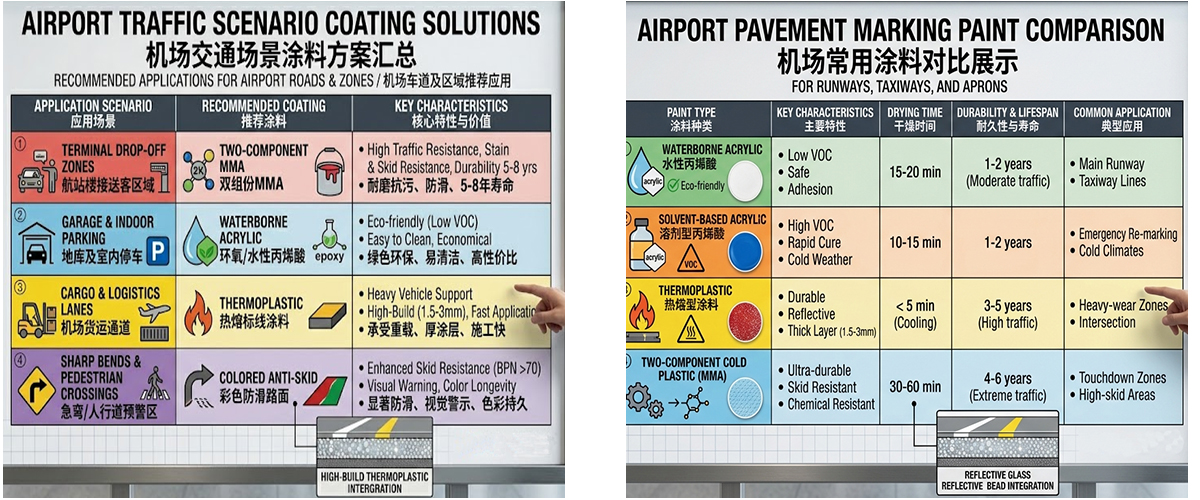
Airport runway marking follows specific industry standards. According to the Civil Aviation Administration of China’s latest “Technical Specifications for Basic Maintenance of Civil Airport Flight Areas” (MH/T 5086-2025), thermoplastic type road marking paint are prohibited for runway markings in airport activity areas. Currently, water-based acrylic road marking paint are primarily recommended for airport runway marking, solvent-based or two-component can also be considered in specific situation. Below is a comparison of them types:
1. Water-Based Acrylic Road Marking Paint
Water-based acrylic road marking paint is an environmentally friendly. It is composed of water-based acrylic emulsion, pigments, fillers, water, film-forming aids, etc., and is less harmful to the environment compared to solvent-based road marking paints. This paint dries quickly, accelerating construction and reducing postpone time.
Features:
- Low VOC: Water-based formula, lower emissions of volatile organic compounds (VOCs), friendly environment construction workers and the environment.
- Quick Drying: For airports, rapid drying is crucial because airports must minimize runway closure time.
- Easy to Apply: Support brush/roller/spray, making them easy for many contractors to use.
Usability Evaluation: Highly recommended; this is currently the most widely used type in airports both domestically and internationally (complies with international standards such as US FAA P-620).
2. Solvent-Based Road Marking Paint
Solvent-based road marking paint is a traditional choice that has been used for many years. It is composed of acrylic resin, organic solvents, pigments, fillers, and additives, and is known for its durability and abrasion resistance. Because its long service life, it is often the first choice for high-traffic areas, including airport runways.
Features:
- High Durability: Solvent-based paints can withstand harsh weather conditions and high traffic volume, making them ideal for runways.
- Excellent Adhesion: This type of paint adheres well to various surfaces, ensuring long-term visibility of the markings.
- Poor Environmental Friendliness
Usability Evaluation: If environmental requirements are not high, also highly recommended.
3. MMA (Methacrylic Acid) Road Marking Paint
MMA is a two-component line marking paint. It is composed methyl methacrylate (MMA) resin, two components (A and B), pigments, fillers, glass beads, etc.
Features:
- Extremely high abrasion resistance and adhesion, long-lasting reflective properties
- Suitable for areas with high durability requirements
- Complex application: Two-component mixing on-site requires special equipment and processes, and price is also more expensive than others type.
Usability Evaluation: Due to requires for on-site mixing, high equipment and process requirements, and high costs, not easy to ship in international trade , it is a preferred option if sufficient budget and have professional application equipment and teams.
4. Thermoplastic Road Marking Paint
Thermoplastic road marking is powder marking paint. It is made from C5 petroleum resin, pigments, fillers, glass beads, plasticizers, etc. It is a solid powder at room temperature, but needs to be heated to 180℃-220℃ to melt into a liquid by special machine during construction. It is then scraped or sprayed onto the road surface and crystallizes into a film after cooling. Because raw material cost is low, it is most commonly used on urban roads.
Features:
- Lower cost: Relatively low raw material and construction costs
- Thicker coating provides basic structural strength
- Prone to softening and cracking
Usability Evaluation: Its use is strictly prohibited due to the FOD risks it poses; it has been explicitly banned by the Civil Aviation Administration of China.
Based on the above understanding of coatings, airport runway road marking paint also needs to consider compatibility and re-coating. In runway maintenance, the compatibility between new and old coatings is crucial. According to regulations, only water-based paints can be re-coated over any type of old coating,but solvent-based and two-component(MMA) road marking paints cannot be arbitrarily re-coated onto incompatible old lines, otherwise it will lead to peeling. This is one of the important reasons why water-based paints are the preferred choice. This is also the safest solution, most in line with FAA P-620 standards.
Furthermore, the balance between performance and cost is also an important factor. Although two-component road marking paints(MMA) have the better performance, their application complexity and cost are also the highest. For high-traffic runway core areas, MMA, with its high durability and long-lasting reflective properties, is the best choice; while for general taxiways or aprons, water-based paints is best choice, because of their convenience, friendly environmental , and sufficient performance, become the most economical and efficient choice.
Here are some factors to consider when choosing airport runway marking paint:
1. Traffic Flow and Type: The traffic flow and type on the runway are key factors in determining the appropriate paint. High-traffic runways may require more durable paints, such as solvent-based or specialized runway paints, to withstand aircraft wear.
2. Application Method: The application method also affects paint selection. Some paints require specialized equipment, while others can be applied using standard road marking machines. Ensure the selected paint is compatible with existing equipment.
3. Regulatory Compliance: Airports must comply with strict regulations regarding runway markings. Choosing paint that meets aviation authority standards is essential to ensure the markings are compliant and safe.
4. Budget: Finally, budget constraints will play a significant role in the decision-making process. While specialized runway coatings may offer superior performance, they can also be more expensive. Balancing cost, performance, and safety is crucial.
Choosing the right road marking paint for an airport runway is a crucial decision that directly impacts safety and operational efficiency. If you’re currently looking for suitable paint for your airport runway marking project, suggest to choose Forest Paint’s water-based acrylic marking paint, and they also offer free samples for testing.
Post time: Jul-15-2026