

For steel structure buildings, fireproofing is mandatory. Although steel itself does not burn, its strength decreases rapidly at high temperatures, leading to structural collapse. Fire protection measures must be taken for steel structures, and applying fire resistant coatings is one of the most common and essential methods to achieve this. Today, we will introduce how to choose and use fire resistant coatings for steel structures.
Fire resistant coatings for steel structures are divided into intumescent and non-intumescent types. Below is a brief introduction to their differences:
|
Features |
Intumescent fire resistant coating |
Non-intumescent fire resistant coating |
|
Antifire Mechanism |
When exposed to fire, the coating foams and expands to form a carbonized layer, thus isolating oxygen and slowing the spread of the fire |
The coating no expand when exposed to fire; it relies on its thickness and low thermal conductivity to block heat |
|
Coating Thickness |
Thin, typically 1.5-2mm |
Thick, typically 15-50mm, or even thicker |
|
Appearances |
Ultra-thin type smooth surface; thin type rough surface ; |
Relatively rough surface with poor decorative effect, more suitable for use in unseen areas |
|
Antifire time Limit |
≤ 2.5 hours |
≥3hours |
|
Main limitations |
High requirements for construction materials (such as anti-corrosion paint) and adaptability to outdoor environments |
thick coating, poor appearance, long construction period, and impact on structural load |
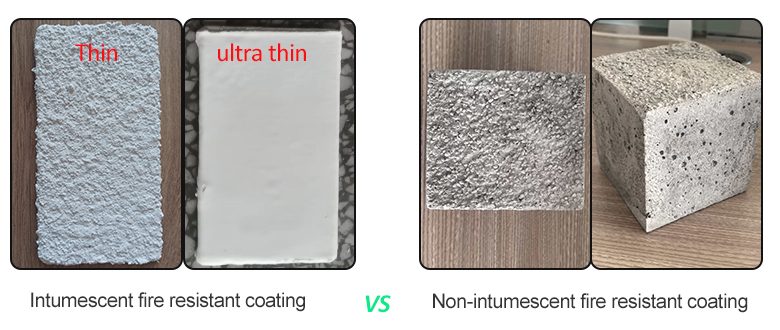
Now we know their information and differences, let me tell you how to choose the suitable for you fire resistant coating: For indoor spaces with high aesthetic requirements, such as shopping malls, office buildings, exhibition halls, and airport waiting halls, steel beams and columns are exposed, and not only require beautiful outlook but also good antifire performance, if antifire time requirement of less than 2 hours( or 2.5 hours), suggest to use intumescent fire resistant coatings. For light steel structures and space frame structures, also suggest to use intumescent fire resistant coatings, because these structures are load-bearing sensitive, and the lightweight nature of intumescent coatings is a significant advantage.
For high-rise steel structure columns and load-bearing components, where structural safety is more important than decorative effect, and for industrial heavy-duty or petrochemical projects such as industrial plants and petrochemical facilities with extremely high fire protection requirements, suggest to choose non-intumescent fire resistant coatings; for antifire time requirements ≥3h; and for concealed structures and steel structures with less emphasis on decorative features, non-intumescent fire-retardant coatings should also be given priority.
While intumescent fire resistant coatings price are more expensive, they require less dosage and are easy to apply. Non-intumescent type price are cheaper t, but their coatings are thicker, requiring a larger amount per unit area, so the material cost is not necessarily lower. (The coating thickness of non-intumescent type should not be less than 15mm, otherwise, it is difficult to guarantee the quality of application and the antifire effect.)
In short, it’s essentially a trade-off between “aesthetics and lightweight” and “fire resistance and durability.” If the project is indoors and aesthetics are a priority, intumescent coatings are the first choice; however, if it involves critical load-bearing parts of heavy-duty industrial buildings or high-rise steel structures, non-intumescent coatings, with their stability and high fire resistance, are a more reliable foundation.
After chose the suitable for fire resistant coating, correct construction is key to achieving the best results. Here are some effective construction tips:
1) Surface Treatment: Ensure the steel surface is clean, dry, and free of rust or contaminants. Applying a layer of anti-rust primer can enhance adhesion and improve overall performance. This is crucial for ensuring a secure bond between the fire retardant coating and the steel structure and must not be omitted.
2) Thickness is a crucial indicator: The national standard GB 14907-2018, 《Fire Resistive Coatings for Steel Structures》,clearly stipulates that the coating thickness of intumescent fire resistant coatings should not be less than 1.5 mm, and the coating thickness of non-intumescent fire resistant coatings should not be less than 15 mm. This is a basic requirement to ensure construction quality and fire-retardant effect. At the same time, the manufacturer’s guidelines regarding coating thickness, drying time, and environmental conditions should be followed. This will ensure that the coating achieves its expected performance.
3) Regular maintenance: Regularly inspect the coating surface for signs of wear or damage. Address any issues promptly to maintain the fire resistance rating.
When using intumescent fire resistant coatings, it is crucial to ensure compatibility and compatibility with the underlying anti-corrosion coating and topcoat; otherwise, the intumescent effect may be compromised, potentially leading to coating peeling. The typical application sequence is: anti-corrosion primer → anti-corrosion intermediate coat → intumescent fire resistant coating → anti-corrosion topcoat. For more information on fire resistant coatings, please contact Forest Paint, a leader in the industry.
Post time: Jun-24-2026