
When you are managing a 50,000-square-foot distribution center or a high-intensity commercial kitchen, the floor is rarely the first thing on your mind—until it fails. In the industrial world, a floor isn’t just a surface to walk on; it is a foundational asset that dictates your operational rhythm. Choosing between polyurethane (PU) and epoxy isn’t just a matter of color or cost; it is a high-stakes engineering decision that impacts your facility’s safety, longevity, and bottom line.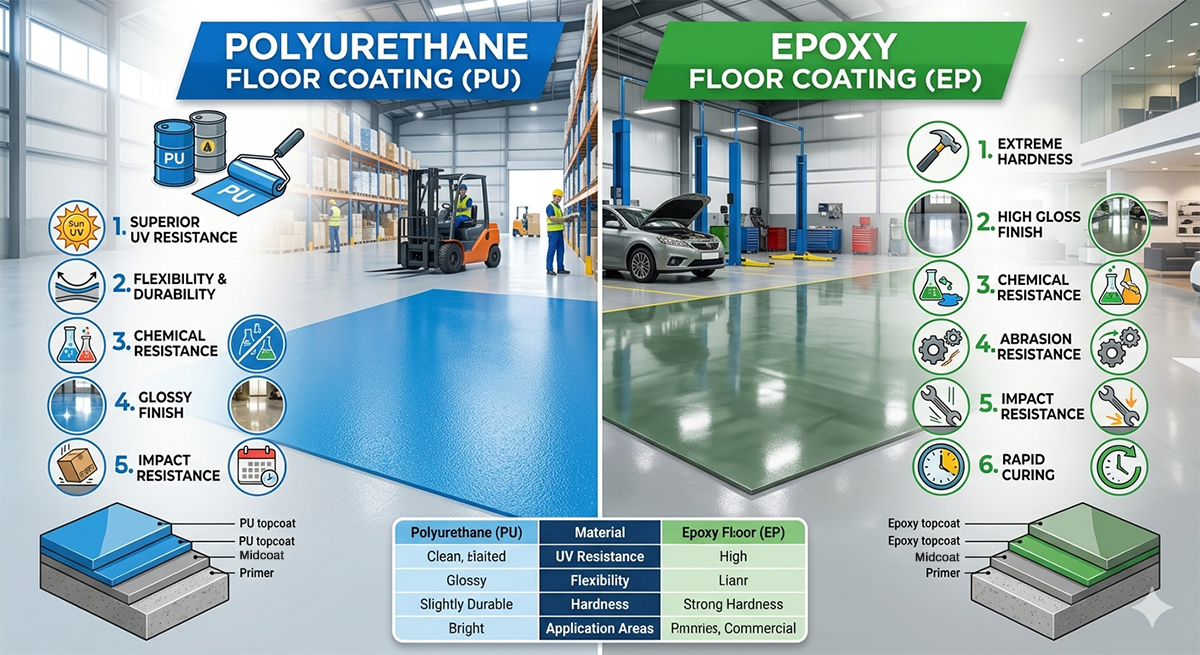
For years, these two coatings have been the twin pillars of the industry. Yet, they are frequently misunderstood, misapplied, and mistakenly treated as interchangeable. To get the best Return on Investment (ROI) in 2026, you need to look past the marketing gloss and understand the molecular grit.
The Heavyweight: Epoxy Floor Paint
If your facility is the theater of “heavy lifting,” epoxy is your lead actor. Epoxy is a thermosetting resin, created through a specific chemical reaction between a base resin and a polyamine hardener. Think of it as a chemical handshake that results in a rigid, plastic-like lattice.
Why Epoxy Dominates the Floor
The standout feature of epoxy is its compressive strength. It doesn’t just sit on top of concrete; it anchors into the pores of the substrate, creating a mechanical bond that is often stronger than the concrete itself. This makes it the undisputed champion for:
-
Heavy Traffic: Where forklifts with solid tires carry multi-ton loads 24/7.
-
Surface Leveling: Epoxy is naturally high-build and self-leveling. It can fill in minor cracks and “pockmarks” in old concrete, leaving a glass-smooth finish.
-
Chemical Resistance: It stands up incredibly well to industrial solvents, alkalis, and even battery acids—making it a staple in automotive and aerospace hangars.
The Achilles’ Heel
However, epoxy’s greatest strength—its rigidity—is also its biggest weakness. Epoxy is brittle. It doesn’t “give.” If the concrete beneath it shifts due to settling or thermal expansion, the epoxy won’t flex; it will crack. Furthermore, epoxy is notoriously “allergic” to the sun. Traditional epoxy resins suffer from UV degradation, leading to “chalking” (a powdery surface residue) and yellowing. If you’re coating an outdoor loading dock, epoxy is essentially a ticking clock of aesthetic failure.
The Flexible Powerhouse: Polyurethane (PU)
If epoxy is a suit of armor, polyurethane is a high-tech athletic compression suit. While it also consists of two components, its molecular structure is far more “elastic.”
The Resilience Factor
Polyurethane coatings are defined by their impact resistance. In a busy workshop where heavy tools are dropped, or in a warehouse where pallets are dragged, PU acts as a shock absorber. It can take a hit and “bounce back” where epoxy might chip or shatter.
Key advantages include:
-
Thermal Shock Resistance: This is the “secret sauce” for the food and beverage industry. In a commercial bakery or a cold storage facility, the floor might go from 0°C to 80°C in minutes during a wash-down. Polyurethane expands and contracts with these temperature swings, preventing the delamination (peeling) that plagues rigid coatings.
-
Chemical Specialization: While epoxy handles solvents, PU is the king of resisting organic acids. If you’re dealing with milk (lactic acid) or fruit juices, PU is your only viable long-term defense.
-
UV Stability: Unlike epoxy, aliphatic polyurethanes are UV-stable. They maintain their color and gloss even under the punishing glare of the sun or high-intensity warehouse lighting.
The Speed Advantage
In 2026, downtime is the ultimate “profit killer.” Polyurethane systems typically cure much faster than epoxies. While an epoxy floor might need three to five days to reach full chemical maturity, many PU systems can handle foot traffic in 6 hours and heavy loads in 24.
Head-to-Head: The Performance Breakdown
| Feature | Epoxy Floor Coating | Polyurethane (PU) Coating |
| Bonding Strength | Superior; penetrates concrete deeply. | Moderate; requires a clean, primed surface. |
| Flexibility | Low; prone to cracking under stress. | High; excellent impact and crack bridging. |
| UV Resistance | Poor; yellows and chalks in sunlight. | Excellent; color-stable and gloss-retentive. |
| Build Thickness | High-build (can be applied thick). | Low-build (usually thin film). |
| Thermal Shock | Poor; brittle at extreme temps. | Exceptional; handles rapid temp changes. |
Preparation: The Unsung Hero of Success
Before a single drop of resin hits the floor, the battle is won or lost in the surface preparation. You can buy the most expensive polyurethane on the planet, but if you apply it over a floor with “laitance” (that dusty top layer of new concrete) or oil contamination, it will fail within six months.
In 2026, the industry has moved away from simple acid etching toward mechanical profiling. Diamond grinding or shot-blasting are now the gold standards. This creates a “profile” (think of it like tiny mountain peaks) that gives the resin a massive surface area to grip.
Pro Tip: Always check the Moisture Vapor Emission Rate (MVER). Concrete might look dry on top, but it acts like a sponge. If moisture is rising from the earth through the slab, it will create osmotic blisters under your coating. High-moisture areas require a specific moisture-mitigating epoxy primer before the main coat goes down.
The 2026 Digital Shift: How Pros Source Coatings
The way B2B buyers procure industrial coatings has undergone a digital revolution. We are no longer in the era of “calling the guy who knows a guy.” Today, procurement is driven by data-backed specifications and high-fidelity visual trust.
The Rise of Intent-Driven Sourcing
Facilities managers now use “surgical” search terms. Instead of searching for “floor paint,” they are looking for “low-VOC anti-microbial polyurethane” or “self-leveling ESD-safe epoxy.” If a manufacturer’s digital presence doesn’t lead with these technical specs, they aren’t even in the running.
Visual Validation
In the digital marketplace, “seeing is believing” has been replaced by “high-resolution rendering.” Buyers expect to see exactly how a 3mm epoxy flake system looks under 5000K LED lighting. High-definition imagery (1000px+, 300ppi) isn’t just a luxury; it’s a trust signal. If a company can’t provide a clear, realistic visual of their product in a real-world setting—like a bustling fulfillment center or a pristine pharmaceutical lab—buyers assume the product quality matches the poor imagery.
The Golden Standard: The Hybrid System
Why choose one when you can have both? The most sophisticated industrial floors in 2026 are hybrid systems.
Contractors often use epoxy as the primer and body coat. This leverages epoxy’s incredible adhesion to concrete and its ability to build thickness and smooth out the floor’s profile. Once the epoxy has leveled the “terrain,” they apply a polyurethane topcoat.
This “mullet” strategy (business-strength epoxy on the bottom, party-flexible PU on the top) provides:
-
The structural “anchor” of epoxy.
-
The scratch and UV resistance of polyurethane.
-
The chemical protection of a dual-layered barrier.
It is, quite literally, the best of both worlds.
Conclusion: Making the Strategic Call
Choosing the right floor coating requires a cold, hard look at your environment.
-
If you are running a heavy manufacturing plant with massive static loads and no sunlight, Epoxy is your workhorse.
-
If you are managing a food processing plant, an outdoor plaza, or a high-traffic retail space where downtime must be minimized, Polyurethane is your MVP.
Ultimately, the floor is the silent partner in your business’s success. By understanding the chemistry behind the coating and the digital landscape of modern procurement, you aren’t just buying paint—you’re investing in an operational foundation that will stand the test of time, traffic, and technology.
Post time: Apr-03-2026