
In the evolving world of industrial and commercial flooring, epoxy coatings continue to stand out for their resilience, aesthetic flexibility, and long-term performance. Among the spectrum of options available, epoxy self-leveling floor coatings and epoxy floor coatings represent two fundamentally different approaches—each tailored to specific functional and environmental needs. While many resources highlight their basic attributes, this guide delves deeper into their structural differences, performance under stress, lifecycle value, and ideal use cases—offering a fresh perspective for facility managers, architects, and business owners looking to make an informed, future-ready decision.
Understanding Epoxy Coatings: Beyond the Basics
Epoxy resin systems are formed through the chemical reaction of resin and hardener, resulting in a rigid, cross-linked polymer. Known for exceptional bond strength, chemical resistance, and durability, epoxy has become the material of choice for environments that demand hygiene, safety, and minimal maintenance. However, not all epoxy finishes perform alike—their formulation, thickness, and application methodology define their real-world behavior.
Epoxy Self-Leveling Floor Coatings: The High-Performance Seamless Solution
What Sets It Apart:
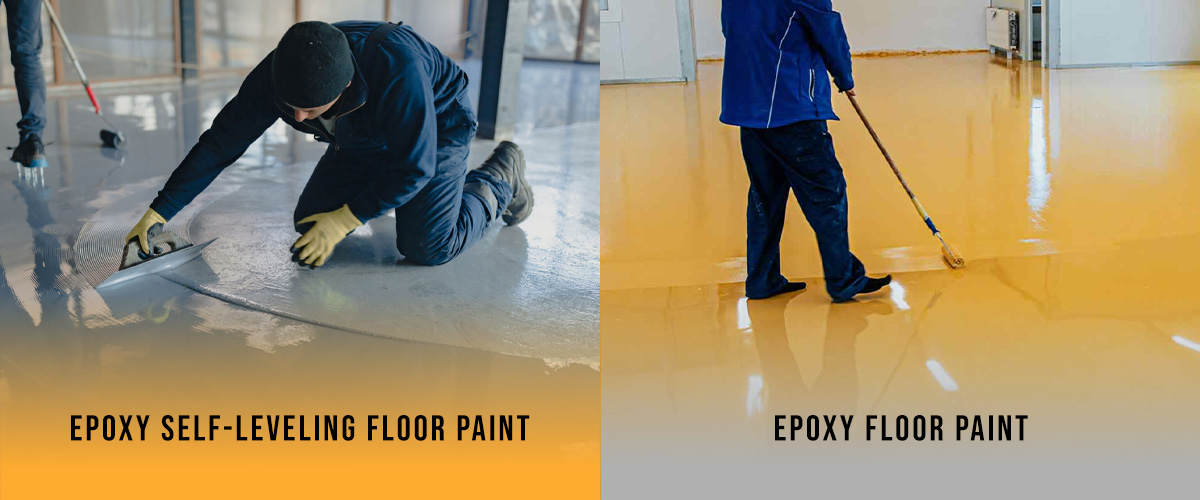
Self-leveling epoxy is engineered not just as a coating but as a resurfacing system. With a higher viscosity and specialized flow-enhancing additives, it is designed to be poured and spread, creating a uniform, seamless surface that masks subfloor imperfections.
Advanced Application Insights:
While surface preparation is critical for all epoxy systems, self-leveling demands near-perfect substrate conditioning. Beyond grinding or blasting, moisture testing and crack injection may be necessary to prevent future reflective cracking. The mixing phase is precision-dependent; even slight deviations in ratio can affect cure time, gloss retention, and mechanical properties. Post-pour, professionals often use spiked rollers to eliminate trapped air, ensuring a void-free surface. The finished thickness typically ranges from 2 to 5 mm, providing not just a coating but a wear layer capable of absorbing impacts.
Performance Advantages in Detail:
Hygienic & Safety Surface: The lack of seams and joints prevents bacterial growth and allows for easy, thorough cleaning—making it indispensable in pharmaceuticals, food processing, and healthcare.
Heavy-Duty Load Bearing: With compressive strength often exceeding 60 MPa, it withstands prolonged forklift traffic, pallet jack loads, and heavy static loads without cracking.
Chemical & Thermal Resilience: Resists not only common oils and solvents but also mild acids, alkalis, and thermal cycling—suitable for labs, automotive shops, and cold storage.
Customization & Brand Integration: Through chip broadcasts, color quartz infusion, or even conductive additives for static control, self-leveling epoxy can be both functional and highly branded.
Where It Shines: Automotive plants, distribution warehouses, beverage production facilities, cleanrooms, and high-traffic retail environments.
Epoxy floor Coatings (Epoxy Floor Paint): The Economical Protective Layer
What Sets It Apart:
Often called epoxy floor paint, this is a thin-film coating applied via roller or brush, typically at dry film thicknesses between 0.2–0.5 mm. It does not level on its own and is intended primarily as a protective and aesthetic layer over sound concrete substrates.
Application Nuances:
Surface prep, while essential, can be less exhaustive than for self-leveling systems—repairing major cracks and ensuring cleanliness is usually sufficient. Application is accessible to skilled DIYers, though professional application ensures even thickness and longevity. Multiple coats are standard to build chemical resistance and hide substrate color. Cure times are shorter, but full mechanical strength develops over days.
Performance Advantages in Detail:
Cost-Effectiveness: Material and labor costs are significantly lower, offering a viable solution for large-area coverage on a budget.
Rapid Return to Service: Many formulations allow light foot traffic within 12–24 hours, minimizing operational downtime.
Sufficient Chemical & Abrasion Resistance: For environments without constant exposure to aggressive chemicals or heavy impact, a well-applied floor coating provides years of reliable service.
Aesthetic Variety: Available in satin, floor, or semi-gloss finishes, with flake or metallic options for decorative enhancement in showrooms, offices, or residential garages.
Where It Shines:
Retail stores, school hallways, office buildings, light workshops, residential garages, and restaurants (excluding kitchen areas).
Head-to-Head Comparison: Key Differentiators
|
Aspect |
Epoxy Self-Leveling |
Epoxy floor Coating |
| Primary Function | Resurfacing & structural enhancement | Surface protection & aesthetic renewal |
| Thickness | 2–5 mm | 0.2–0.5 mm |
| Surface Finish | Seamless, glossy, often high-gloss | Texture-dependent, usually floor or satin |
| Application Skill | Professional required | DIY-friendly with proper prep |
| Crack Bridging | Excellent (hides minor cracks) | Minimal (may show substrate imperfections) |
| Installation Time | Longer (including cure) | Faster turnaround |
| Longevity in Heavy Use | 10+ years with proper maintenance | 3–7 years depending on traffic |
| Cost per sq. ft. | Higher upfront, lower lifecycle cost | Lower upfront, potential earlier recoating |
Making the Right Choice: Factors Beyond Cost
Substrate Condition:
Self-leveling is forgiving to uneven or slightly damaged floors; floor coatings require a sound, smooth substrate.
Operational Demands:
Consider daily traffic type—static loads, rolling loads, chemical spills, cleaning regimens, and thermal exposure.
Downtime Allowance:
Self-leveling may require 3–7 days before full operation; floor coatings offer quicker accessibility.
Future-Proofing:
If future changes in space use are likely (e.g., converting storage to production), investing in self-leveling provides flexibility.
Sustainability & Health:
Low-VOC and UV-stable formulations are available in both types, contributing to better indoor air quality and reduced yellowing.
Industry Trends & Innovations
Polyaspartic Hybrids: Faster cure versions of self-leveling systems, allowing installation in temperature-sensitive environments.
Anti-Microbial & VOC-Capturing Epoxies: Especially relevant for healthcare and education sectors.
Decorative 3D & Terrazzo Effects: Both coatings can be enhanced with decorative aggregates, but self-leveling offers a more integrated finish.
Smart Flooring: Conductive and ESD (electrostatic dissipative) options are increasingly available in self-leveling formulations for tech and laboratory settings.
Conclusion
Epoxy self-leveling and epoxy floor coatings serve distinct purposes in the world of industrial and commercial flooring. The former is a long-term, high-performance investment ideal for demanding environments where durability, safety, and cleanliness are non-negotiable. The latter is a cost-effective, aesthetic, and functional solution for lighter-duty spaces where budget and speed are priorities.
By aligning your choice with operational needs, substrate conditions, and future facility plans, you not only protect your asset but also enhance its functionality and visual appeal. In an era where floors contribute to brand perception, workflow efficiency, and sustainability goals, selecting the right epoxy system is more than a maintenance decision—it’s a strategic business move.
Post time: Dec-19-2025